Austria
 Belgium
 France
 Germany
 Italy
 Netherlands
 Poland
 Spain
 Sweden
 United Kingdom
 United States

Many Irish companies start out with the owner’s own mobile on the website, the van and the quote template. That works until the business grows: the same number then carries customer calls, supplier calls and private calls, nobody else can pick up when the owner is with a client, and if the person who handles sales leaves, the number that customers have saved leaves with them. A separate business phone number solves that, because it belongs to the company rather than to a handset or an employee.
A business number is a line that customers, prospects and partners call, and it rings through to whichever phones your team already uses. CallFactory supplies local, 0818 and 1800 numbers in Ireland and connects them to mobiles, desk phones or a softphone, so you can start taking calls on a proper business line without new hardware. You can compare the number types and order one on our Irish phone numbers page.
Why a business phone number works better than a personal mobile
The first reason is continuity. A number printed on invoices, vans, directory listings and your Google Business Profile builds up value over the years, and that value should stay with the company when staff change roles, go on leave or move on. With a business number you simply point the calls at someone else, while customers keep dialling the number they know.
The second reason is control over who answers. A personal mobile rings on one handset only, whereas a business number can ring on several phones at once or one after another, so a colleague covers while you are on a job in Galway or at a trade show. Outside opening hours the call can go to voicemail, to whoever is on call or to a recorded message, instead of ringing the owner’s own phone late in the evening.
The third reason is how callers see you. A recognisable Irish number on your website tells a buyer that there is an organisation behind the line, and it lets you separate sales and support on different numbers so that each enquiry reaches the right person first time.
Which types of Irish business phone number exist
Irish numbering is managed by ComReg, and it gives a business three main choices, each of which says something different to the caller.
- Local geographic numbers. These carry an area code such as 01 for Dublin, 021 for Cork, 091 for Galway or 061 for Limerick. They suit firms that serve a town or region, such as solicitors, accountants, GP surgeries and trades, because the caller sees a business nearby. You choose from our local numbers, for example a Dublin 01 number or a Cork 021 number. A local number used this way is often called a virtual landline.
- National 0818 numbers. An 0818 number is one number for all of Ireland, not tied to an area code, and a call to it is charged like a standard call to a landline, usually within the caller’s bundle. It works well as one number for sales, bookings and general enquiries across every county.
- 1800 Freephone numbers. On a 1800 number the caller pays nothing from an Irish landline or mobile, while the business pays for the incoming calls. That makes Freephone the natural choice for helplines, customer service and campaigns that aim for as many inbound calls as possible.
0818 and 1800 numbers can be called only from within Ireland. The old 1850 and 1890 numbers have been withdrawn by ComReg, so a business that still prints one needs a new number, and an 0818 number can take its place.
How calls to your business number reach your team
A business number is not tied to a SIM card or a copper line, which is why it is often called a virtual number (our guide on what a virtual phone number is explains the technology). When a customer dials it, the call enters our network and is delivered wherever you choose: a mobile, a desk phone at the office, a colleague working from home, a second office, an external call centre or our voicebot that answers every caller straight away.
You set that routing yourself in the dashboard. With call forwarding you send calls to one phone or to a group, ringing at the same time or in turn, and you can change the destination right away when someone is out sick or at a client. If different people are on duty on different days, rota-based routing lets you plan that weeks ahead, so evening and weekend calls reach whoever is on call without anyone changing settings by hand.
Staff who want business calls on their own phone can have the business number on their mobile: the call rings as a normal incoming call, without an app, and stays separate from their personal line. We deliver the call over the fixed and mobile network by default, or over VoIP when you would rather use that, and you can mix both within the same team.
What you need to register an Irish business number
ComReg sets clear rules for who can hold an Irish number. Every Irish number type (local, 0818 and 1800) needs a verifiable Irish address and an Irish company registration, which means a CRO number. A local number also needs premises inside its area code plus one proof of that address, so a firm with an office in Limerick gets a 061 number rather than a Dublin 01. A company from the Netherlands or Germany that opens its first Irish line needs the same: an Irish address and a CRO number.
In practice you supply your company name, CRO number, the Irish business address and a contact person when you order. We check the address and the registration ourselves, and once the address is verified the number is live within one working day. If you already have a business number with another provider, you can port it to us free of charge. Porting takes at most five working days and the number keeps working in the meantime, so customers keep dialling the number they already have.
How to choose the right business number for your company
Start with the question of who calls you and from where. If most of your customers are in the town or region around your premises, a local number with that area code is the obvious choice, because it matches what they expect from a nearby supplier. If you sell across the whole of Ireland, an 0818 number gives you one national number at the cost of a standard call, while a 1800 number makes sense once the calls are valuable enough that you want to take the cost away from the caller.
Many companies combine types instead of picking one, for example a local number for the head office, an 0818 number for sales and a 1800 line for customer support. Each number can have its own routing, opening hours and welcome message, while everything runs from the same account. A business with several branches can also put one main phone number in front of all of them.
What you pay depends on the plan and the number type. A Business Number costs €149 a year, Phone System €25 a month and Customer Service €49 a month, prices excluding VAT. Calls on a local or 0818 number are included with normal use; above that you pay 10 cent per minute to Irish mobiles and landlines alike, and those 10 cent include call recording, transcription and logging if you want them. A 1800 number has its own per-minute rate for incoming calls. All plans are on our pricing page.
Getting a business phone number from CallFactory
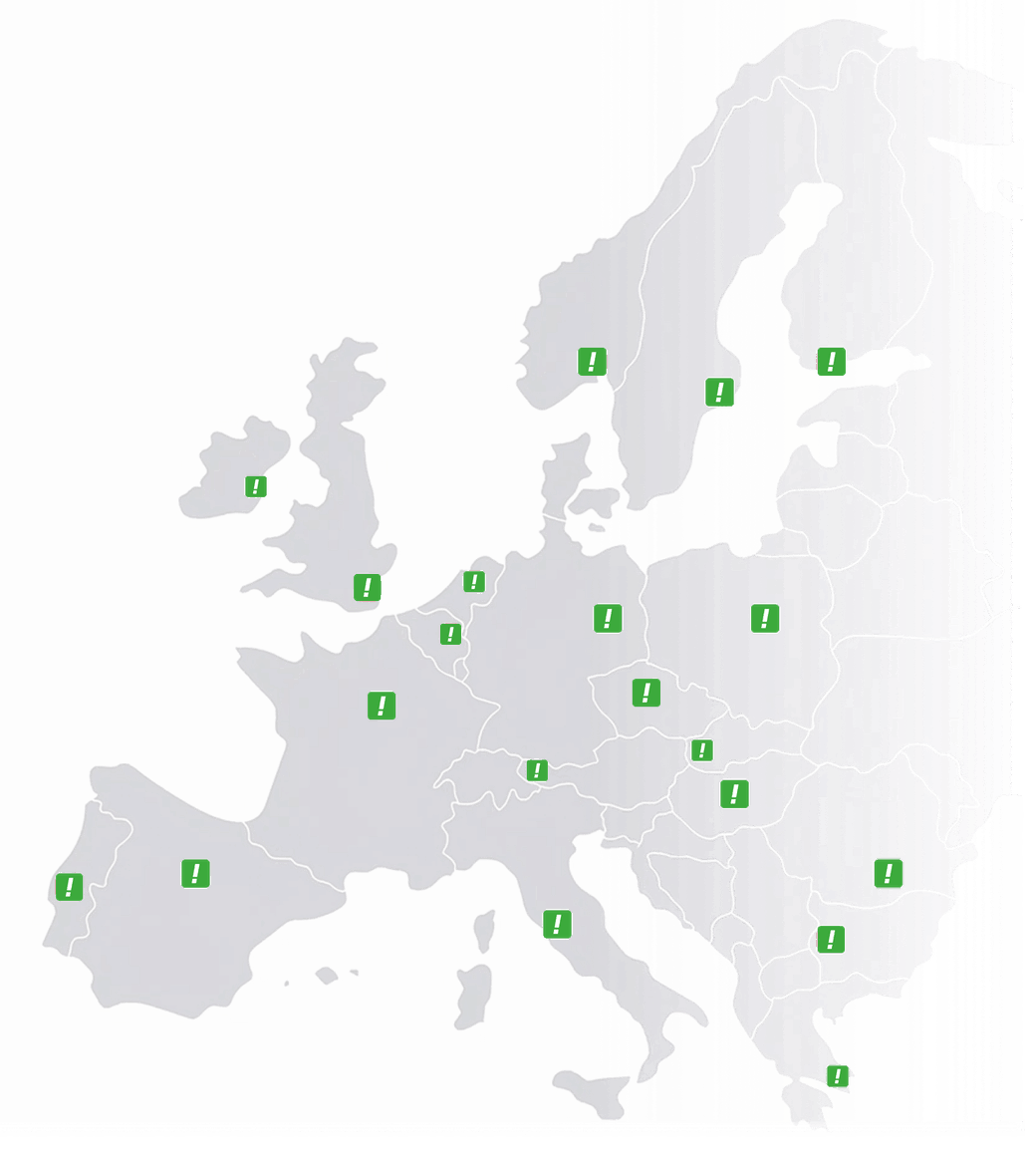
CallFactory has provided business phone numbers since 2001, which gives us more than 25 years of experience in routing inbound calls for companies across Europe. We are registered with ComReg in Ireland under number ERAU10001358, licensed in 14 European countries, and run our own phone platform, so our support team can see and change your routing, call menus and voicebot directly.
Calls to your number are carried over the fixed and mobile network by default, which keeps the audio clear and the connection stable when a customer rings at a busy moment. We set up the number and the routing together with you, so it works the way your team takes calls from the first day, and you keep full control to adjust it whenever the business changes.