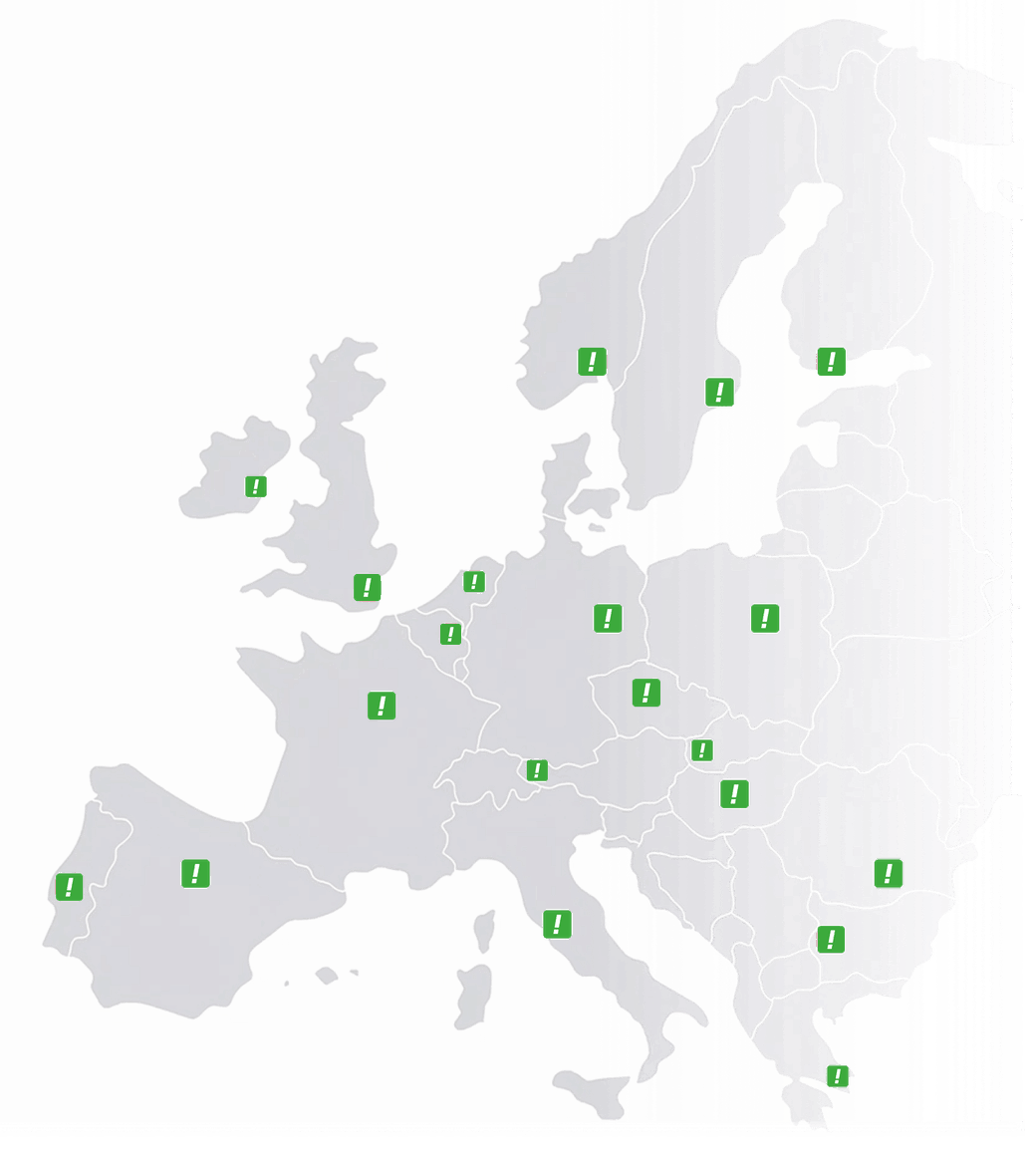
Austria
 Belgium
 France
 Germany
 Italy
 Netherlands
 Poland
 Spain
 Sweden
 United Kingdom
 United States
A customer in Galway who looks up a local supplier tends to trust a number that starts with 091 more than a mobile number or an unfamiliar code, because a local landline suggests a business that is established and easy to reach. Many companies no longer want the physical line that used to come with such a number, though. The team works from several places, the office may move within the town, and calls need to reach whoever is available rather than a single handset on one desk.
A virtual landline solves that by giving your company a real Irish geographic number without the copper line behind it. Customers, prospects and partners call a familiar local number at the normal rate, and the call rings through to the mobiles, desk phones or softphones your team already uses. You choose the area code of your premises among our Irish local numbers, for example a Dublin 01 number or a Cork 021 number.
What is a virtual landline?
A virtual landline is a standard Irish landline number that lives on a telecoms platform instead of on a line into a building. The caller sees an ordinary geographic number and pays the usual rate for calling it, while the platform decides where the call is answered. If you want the wider background on how numbers without a fixed line work, our article on what a virtual phone number is covers that in more depth.
For an Irish business this usually means a number with the area code of the town where it has premises: 01 for Dublin, 021 for Cork, 091 for Galway or 061 for Limerick. Some companies add a national 0818 number when their customers are spread across the country and a regional code would feel too narrow. Both types behave in the same way on the platform, so the choice depends on the image you want your number to give callers and on where your premises are.
Why Irish businesses use a virtual landline number
The most common reason is local presence. A local number on your website, in directories, on quotes and in email signatures tells customers in your area that you are nearby, so they call a number they recognise. A business with premises in more than one town, say an office in Dublin and a branch in Cork, can hold a number for each and have both ring through to the same team.
A second reason is continuity when the office changes. A number that is tied to a line has to be moved with the line, whereas a virtual landline number stays with the company when you move within the area code, go hybrid or change the way the team works. Your customers keep dialling the number printed on years of invoices and vans, and nothing about the move reaches them.
Businesses also use a virtual landline to separate company calls from personal ones, because staff no longer need to hand out their own mobile numbers to customers. When someone changes role or leaves, the business number stays with the company and is simply routed to a colleague. Finally, a single number can be answered by several people, so the enquiry line of a small firm does not depend on one person being at one desk.
How calls to a virtual landline reach your team
Every inbound call first arrives on the platform, which then applies the rules you set. The simplest rule is call forwarding to one or more phones, which you can change at any time when a colleague is out at a client or covering the reception line from home. With calendar-based call routing calls follow your opening hours, so that after closing time they go to the mobile of whoever is on duty or to voicemail.
When the number serves more than one department, a call menu lets callers choose sales, support or accounts before the call rings through. A call queue holds callers in order during busy periods instead of giving them an engaged tone, which matters most for a line that customers ring about orders or appointments, such as a vet clinic at half eight on a Monday.
Many people search for a virtual landline app, but an app is an option rather than a requirement. With your business number on your mobile the call rings on a mobile as a normal incoming call over the mobile network, so nothing needs to run in the background. Colleagues who prefer to answer on a laptop can use a softphone, and an office that likes a handset on the desk can connect a desk phone. You decide per person which of these suits the way they work.
Moving an existing landline number to a virtual one
A business that already has a landline number with eir or another provider does not need to start again with a new one. The existing number can be ported to CallFactory free of charge within five working days, and the number itself stays exactly the same. Customers keep calling it as before, while behind the scenes the calls start to follow the routing rules you set on our platform.
The steps and the information we need are listed on the page about porting an existing number. It helps to keep the old line active until the port has completed, so that no calls are lost during the switch, and to decide in advance which phones the number should ring on from the first day.
What you need to register a virtual landline number in Ireland
ComReg’s rules tie a local number to the place where your business is. To get one you need premises inside the area code, one proof of that address and an Irish company registration (a CRO number). A solicitor’s office in Limerick therefore gets a 061 number and a trades firm based in Galway a 091 number. The location of the people who answer the calls is not relevant, which means a colleague working from home in another county can take calls on your local number.
If your customers are all over Ireland, or your premises are not in the area you want to serve, an 0818 number is the alternative: one number for the whole country, charged like a standard call, which needs an Irish address anywhere in Ireland and a CRO number. In practice you provide the company details and the business address, we check the address ourselves, and once it is verified the number is live within one working day.
Call quality and our own platform
Two things decide how your virtual landline performs. The first is how the call travels once a customer dials your number. CallFactory delivers calls over the fixed and mobile network, so an enquiry arrives with the call quality your customer expects from a landline, and you can still choose VoIP delivery for colleagues who work that way.
The second is who runs the platform behind your number. CallFactory is a licensed telecoms operator in 14 European countries that runs its own platform, and is registered with ComReg in Ireland under number ERAU10001358, so your routing, call menus and fixes are handled by the team that runs the platform. We have been running business telephony since 2001, which is more than 25 years of experience with numbers, routing and porting.
You change the routing yourself in the dashboard. A Business Number costs €149 a year, and calls on an Irish number are included with normal use; above that you pay 10 cent per minute to Irish mobiles and landlines alike, and those 10 cent include call recording, transcription and logging if you want them. Which plan includes opening hours and call menus is on our pricing page, and you can see every Irish number type, including 1800 Freephone and 0818 numbers, on the Irish phone numbers page.